
Can hair porosity change over time?
Short answer: yes, but with a catch. The porosity you were born with is genetic and stays put. What changes is damage-driven porosity, earned over time through everything your hair goes through.
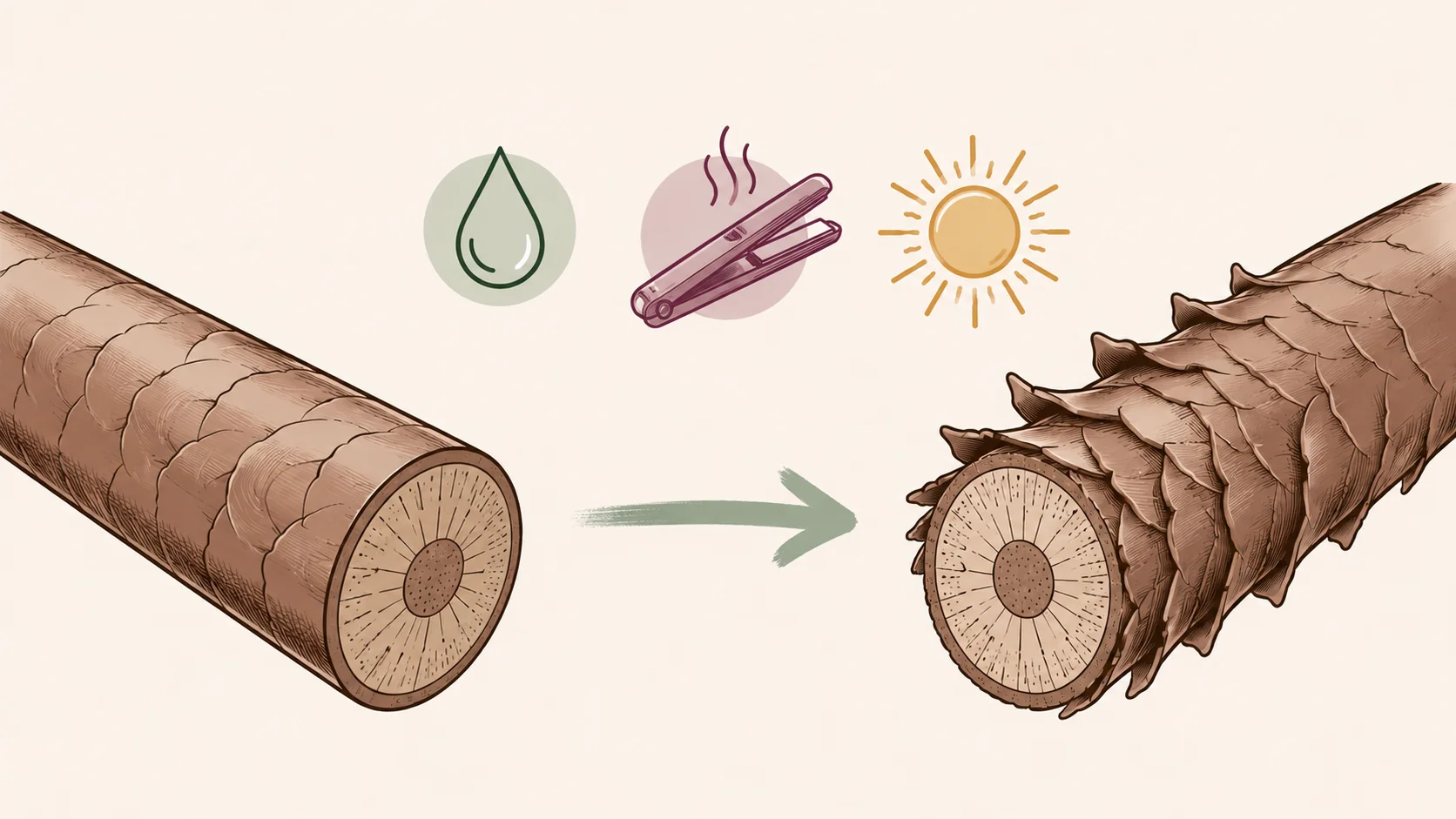
The yes-and-no answer
Porosity is just how easily your hair lets moisture in and how well it holds on to it, and it is governed by the cuticle, the layer of tiny overlapping scales that wraps each strand. When those scales lie flat and tight, water and product struggle to get in, which is low porosity. When they sit raised and open, moisture rushes in and rushes back out, which is high porosity. Most people land somewhere in between.
Here is the part that trips people up. Your natural porosity is genetically determined, the same way your curl pattern and hair thickness are. You were born with a certain cuticle structure, and that baseline does not permanently change. You cannot take a daily oil or do a treatment that converts you from low porosity to high porosity at the root, or back again, on purpose. New hair grows in carrying the porosity your genes set for it.
But, and this is the catch, hair can absolutely become more porous over time. The cuticle is a physical thing, and physical things wear down. Every time the cuticle is lifted, cracked, or stripped, the strand gets a little more porous and stays that way until that hair is cut off. So your baseline is fixed, but the porosity you are actually living with today can drift higher than the hair you were born with. Damage only runs in one direction: toward more porous, never back toward less.
Your natural porosity is set by your genes and does not change. What changes is the porosity of the hair on your head right now, which can rise as the cuticle is lifted and worn down by damage. The drift only goes one way: toward more porous.
What raises porosity
If porosity drifts higher over time, it helps to know exactly what is doing the lifting. Almost everything on this list works the same way: it pries the cuticle open or wears it thin so the strand can no longer hold a tight seal.
- Coloring and especially bleaching. This is the big one. Lightener has to swell and open the cuticle to lift pigment out of the strand, and bleach goes further still, breaking down the inner structure. Color-treated hair is more porous, and bleached hair is dramatically more so. There is no "gentle" bleach that leaves porosity untouched.
- Chemical relaxers and texturizers. Relaxing rearranges the bonds inside the strand and leaves the cuticle permanently more open, which is why relaxed hair so often reads as high porosity and needs richer moisture.
- Frequent heat styling. Flat irons, curling wands, and hot blow-drying repeatedly stress the cuticle. Do it often enough, especially without heat protectant, and those scales stop lying flat and start lifting and chipping.
- Sun and UV exposure. The same rays that fade color degrade the cuticle. A long summer of beach days or daily walks in strong sun can leave your ends noticeably more porous than they were in spring.
- Hard water and mineral buildup. Water heavy in calcium and magnesium leaves deposits that roughen the surface, and over time that wear contributes to a more porous, harder-to-manage strand.
- Rough handling. Aggressive brushing, scrubbing hair dry with a coarse towel, and tight styles that tug all create mechanical friction that lifts and frays the cuticle bit by bit.
Aging plays a quiet role too. As the years pass, the scalp produces less oil and the hair shaft changes, so hair tends to become a little drier and more porous later in life even without any chemical or heat damage. It is gradual, but it is real.
Mixed porosity is normal
Once you understand that porosity rises with wear, one common puzzle solves itself: why your roots and your ends seem to behave like two completely different heads of hair. This is called mixed porosity, and it is not a problem or a sign you did something wrong. It is the default for almost anyone with hair past their shoulders.
The logic is simple. The hair near your scalp is the newest. It has not been colored as many times, ironed as many times, or sat in the sun for as many summers, so it usually keeps a tighter, lower-porosity cuticle. Your ends are the oldest hair on your head: that exact stretch of strand may be three, four, or five years old, and it has lived through every wash, every style, every season since it grew in. So your ends are almost always more porous, drier, and thirstier than your roots.
What this means in practice is that one routine for your whole head can leave you fighting yourself: rich product that finally satisfies your parched ends will sit heavy and greasy on your lower-porosity roots. The fix is to treat them as two zones. Go lighter near the scalp, concentrate your richest moisture, sealing, and bond treatments on the mid-lengths and ends, and stop expecting a single product to be perfect everywhere.
Can you lower porosity?
This is the question everyone really wants answered, so here it is straight: you cannot permanently lower the porosity of hair that is already damaged. You cannot un-bleach a strand. Once the cuticle is cracked open or the inner structure is compromised, that specific hair stays porous until you cut it off. Anyone promising a product that "repairs porosity for good" is overselling.
The honest, useful version of the answer is that you have two real levers:
- Temporarily smooth and seal the cuticle so high porosity hair behaves much better day to day. Cool rinses help the lifted scales lie flatter after washing. Sealing oils and butters lay down over the open cuticle and slow moisture from escaping. Protein and bond-building treatments temporarily fill in and reinforce the gaps in a weakened strand, so it feels stronger and holds moisture longer. None of this rewrites the strand permanently (it wears off and you reapply), but it genuinely changes how your hair looks and feels right now.
- Protect the new growth coming in. The hair at your scalp arrives healthy. If you ease off the bleach, turn the iron down, use heat protectant, wear a hat in strong sun, and handle your hair gently, that new growth keeps its tighter, lower-porosity cuticle for longer. Over months, as you trim damaged ends and healthier hair grows in, the overall porosity of your head genuinely improves, not by reversing damage, but by replacing damaged hair with better-treated hair.
Think of it like skin, not like a stain. You cannot scrub away damage that has already happened, but you can protect what is still healthy and let better hair grow in. Patience and gentler habits do more here than any single bottle.
How to keep up as your hair changes
Because porosity drifts over time, the result you got two years ago is not gospel forever. The smartest move is to treat porosity as something you check in on rather than a label you wear for life. Re-test every so often, and especially after anything that tends to raise it.
- Re-test after a color appointment or a fresh round of bleach, since chemical processing is the fastest way to bump your porosity up a level.
- Re-test after a heavy heat-styling stretch or a long sunny season, when your ends in particular may have crept higher.
- Re-test if your hair suddenly stops responding to its usual routine. Products feeling different is often the first sign your porosity has shifted.
Checking again is quick. You can do the water (float) test at home with a clean strand and a glass of water, or just take the 60-second quiz to get a read plus a routine matched to where your hair is now. If you are not sure what your result even means, start with what hair porosity is, and if your hair has drifted toward the open-cuticle end, the high porosity hair guide covers exactly how to seal, strengthen, and manage it. Adjust your routine as your hair changes, and it will keep working with you instead of against you.
Common questions
Can hair porosity change over time?
Yes. Your natural porosity is genetic and stays the same, but hair can become more porous over time through coloring, bleaching, heat, sun, hard water, and mechanical damage, all of which lift and wear down the cuticle.
Can you permanently lower high porosity hair?
Not permanently. You cannot reverse damage to a strand that already exists. You can temporarily smooth and seal the cuticle with cool rinses, sealing oils, and protein treatments so it behaves better, and protect new growth so it comes in healthier.
Why is my hair a different porosity at the roots and ends?
That is mixed porosity, and it is completely normal. Roots are newer and usually less porous, while ends are older and have been through more heat, sun, and handling, so they tend to be more porous and thirstier.