
Protein vs moisture balance, and how to read your hair
Healthy hair is a balance of protein (strength) and moisture (flexibility). Too much of either and hair breaks. The trick is learning to read which one yours is short on.
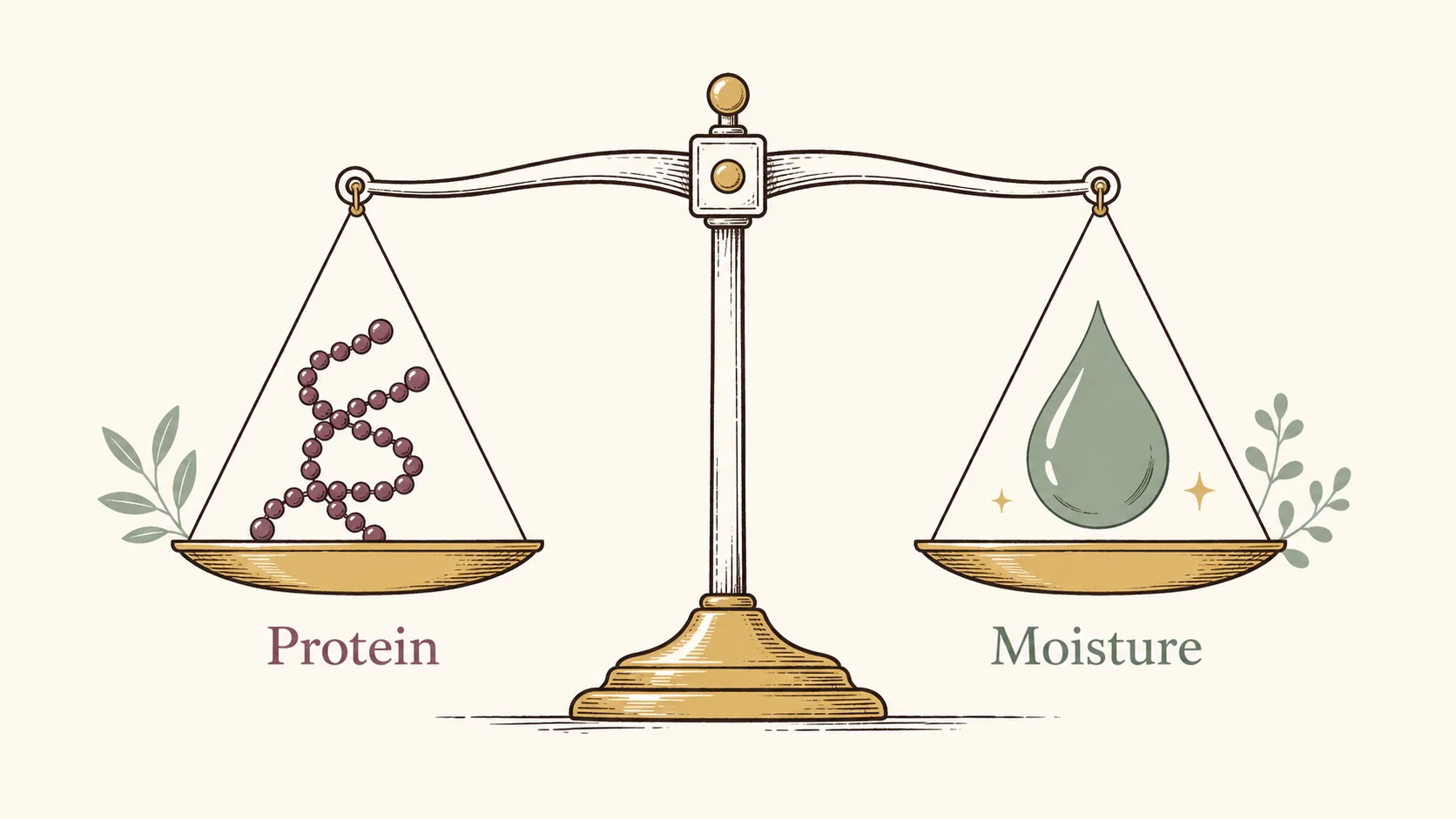
What the balance is
Every strand of hair is a partnership between two things: protein and moisture. Protein is the structure. It is the keratin that forms the strand and gives it strength, the scaffolding that lets your hair hold up under tension without snapping. Moisture is the flexibility. It is the water held inside the strand that keeps it soft, supple, and able to bend and stretch without cracking. One without the other does not work. Pure structure with no water is rigid and brittle; pure softness with no structure is weak and limp.
Healthy hair is the two of them in balance. When the ratio is right, a strand can stretch a little under load, then spring back to where it started. That spring is the whole point. It is how hair survives being brushed, tied up, slept on, and styled day after day without breaking. Most breakage you see is not a mystery and not bad luck. It is one side of the scale tipping too far. Either the strand has gone soft and mushy from too much moisture and not enough protein, or it has gone hard and dry from too much protein and not enough moisture. Read which way the scale has tipped and the fix becomes obvious.
Protein is strength, moisture is flexibility, and you need both. Almost every breakage problem is one of the two being out of balance, not a lack of "good products." Figure out which side is short and you are most of the way to the fix.
Moisture overload vs protein overload
Both extremes lead to breakage, which is why people get them mixed up and reach for the wrong fix. The feel of the hair is what tells them apart. Moisture-overloaded hair has gone too soft; protein-overloaded hair has gone too hard. Here is how each one shows up.
| Too much moisture (needs protein) | Too much protein (needs moisture) |
|---|---|
| Feels mushy, limp, and overly soft | Feels hard, stiff, and straw-like |
| Stretches a long way and does not spring back | Has almost no give and snaps quickly |
| Goes gummy or stringy when wet | Feels dry, rough, and brittle |
| Loses its curl pattern or definition | Tangles, breaks off in small pieces, and looks dull |
| Limp roots, no body, weighed down | Feels rigid and refuses to absorb water |
The shorthand most people remember: mushy means more protein, brittle means more moisture. If your hair feels like wet cotton when it is damp and like a noodle when you stretch it, it has had too much conditioning and not enough structure. If it feels like dry straw that crackles and snaps, it has had too much protein and not enough water.
How to test it
You do not have to guess. The wet strand stretch test reads the balance directly, and it takes about ten seconds. Take a single strand of clean, wet hair, hold it gently between two fingers on each hand, and stretch it slowly.
- It stretches a long way and stays stretched, or breaks while stretched out: your hair needs protein. The structure that should pull it back into shape has gone soft, so the strand keeps going limply instead of springing home.
- It snaps almost immediately with little or no give: your hair needs moisture. The strand is so rigid and dry that it has nothing to flex with, so it breaks the moment you put it under tension.
- It stretches a little and springs back to its original length: this is the goal. Your protein and moisture are in balance, so leave well enough alone.
This is the same thing as the elasticity test, just framed around the protein-moisture question. If you want the step-by-step version with how to read the in-between results, see the hair elasticity test. Test a few strands from different parts of your head, since damage is rarely even, and the ends often read differently from the roots.
How to correct each
Once you know which way the scale has tipped, you nudge it back the other way. The mistake to avoid is doing both at once, or piling on the thing that is already in excess. Correct the side that is too high by easing off it and feeding the side that is short.
If your hair has too much moisture (it is mushy and over-soft):
- Add a protein or bond-building treatment to put structure back into the strand. Start light, because it works fast on hair that is starved of it.
- Ease off heavy conditioners, creamy leave-ins, and rich masks for a while. They are the reason the moisture side ran away.
- Give it a few washes and re-test. The hair should start springing back instead of stretching out. Once it does, return to a normal balance rather than over-correcting into protein overload.
If your hair has too much protein (it is hard and straw-like):
- Deep condition with a rich, moisture-focused mask, and leave it on long enough to soften the strand.
- Clarify off the buildup first so the moisture can actually get in instead of sitting on a coated surface.
- Lead with moisture and back off protein entirely for a stretch. Pause protein treatments, protein leave-ins, and bond builders until the hair feels soft and pliable again.
Go slow and re-test between changes. Both protein and moisture treatments work quickly, and the most common mistake is overshooting: fixing moisture overload so hard that you tip straight into protein overload. Small adjustments, then check the stretch again.
How porosity changes the balance
Your porosity is the clearest clue to where your balance naturally sits, because it decides how easily protein and water get into and out of the strand. This is why two people can follow the same advice and get opposite results.
High porosity hair leans on protein. The cuticle is raised, with gaps along the strand where moisture escapes as fast as it goes in. Protein loves to fill those gaps, temporarily patching the surface, smoothing the strand, and helping it hold on to water. High porosity hair tends to drink up protein treatments and feel stronger and more defined for them. If that sounds like you, the high porosity hair guide walks through a routine built around exactly this.
Low porosity hair leans on moisture. The cuticle lies flat and tight, so the strand already struggles to let things in. Pile protein onto a surface that is already closed and it sits on top, leaving the hair stiff and straw-like fast. Low porosity hair is often protein-sensitive for this reason, and does best leading with moisture and using protein lightly and occasionally. The low porosity hair guide covers how to get that moisture past the surface in the first place.
So before you reach for a treatment, know your porosity. It tells you which side of the scale your hair drifts toward on its own, which means it tells you which direction you are most likely to overshoot. If you have not pinned yours down yet, the quiz takes about a minute and points you straight at the right routine.
Common questions
Does my hair need protein or moisture?
Do the wet strand stretch test: if a wet strand stretches a long way and feels mushy or gummy, it needs protein; if it snaps quickly with almost no stretch and feels dry or brittle, it needs moisture. Healthy hair stretches a little and springs back.
What are the signs of protein overload?
Protein overload makes hair feel hard, stiff, straw-like, and dry, and it snaps easily. Deep condition, clarify off buildup, and lead with moisture for a while, easing off protein treatments until it softens.
How does porosity affect protein and moisture?
High porosity hair usually loves protein because it fills the gaps in a raised cuticle, while low porosity hair is often protein-sensitive and does better leading with moisture. Match your balance to your porosity.