
Hair porosity chart: low, medium and high compared
One chart, three porosity types, side by side. Use it to spot which column sounds like your hair, then jump to the guide for your type.
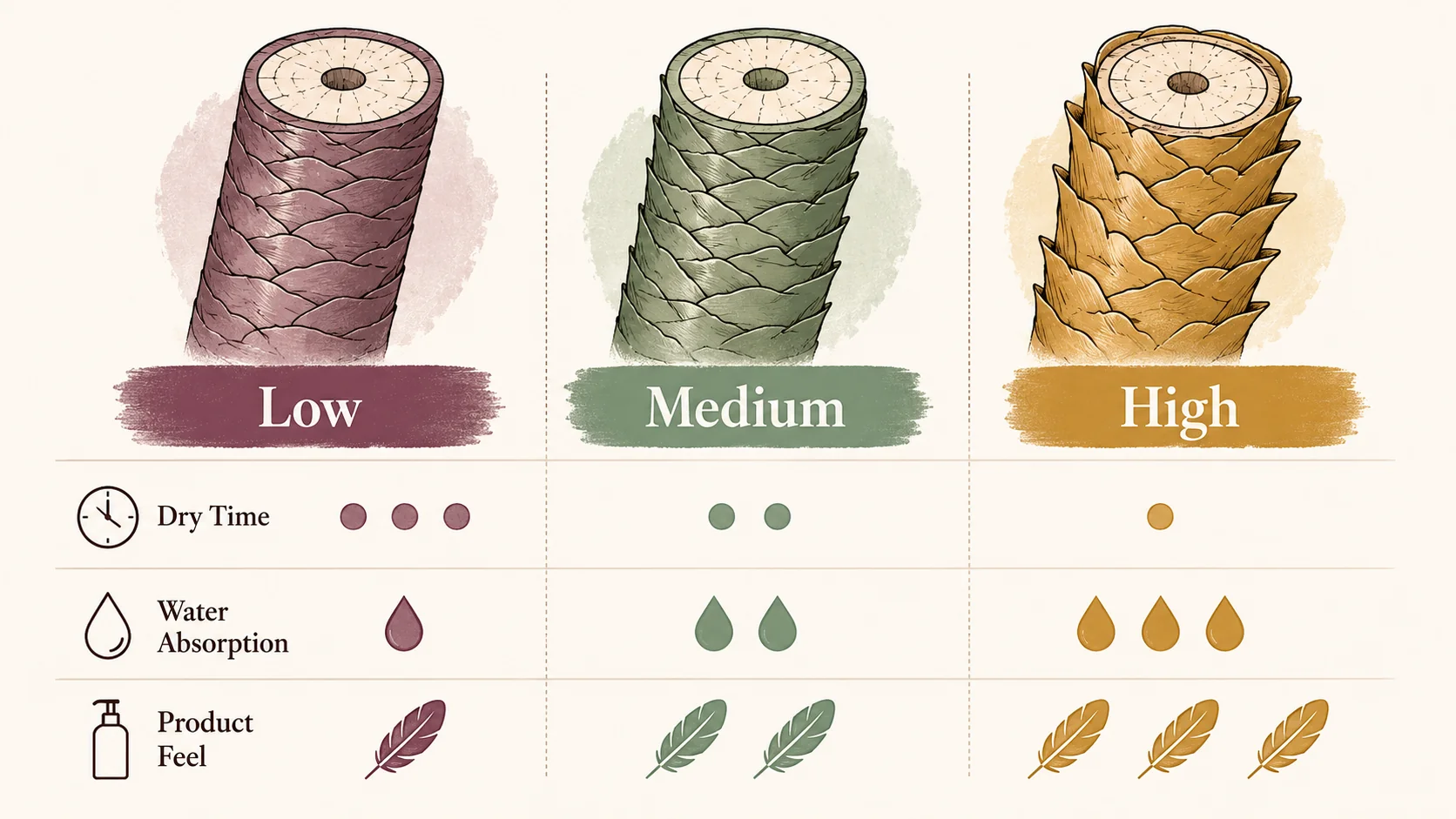
What the chart shows
Porosity is simply how easily your hair takes in and holds on to moisture. It is set by the cuticle, the outer layer of tiny overlapping scales that wrap each strand. When those scales lie flat and tight, water and product struggle to get in. When they sit raised and open, moisture rushes in but leaves just as quickly. Most hair falls somewhere in between.
That single difference (how open the cuticle sits) ripples out into everything you notice day to day: how long your hair takes to dry, whether product absorbs or just coats the surface, and whether you fight buildup or frizz. The chart below lines all three porosity types up side by side so you can read across each row and find the column that sounds the most like your hair.
There is no "good" or "bad" porosity. Each type just needs a routine built around how its cuticle behaves. Knowing your column is the shortcut to the right one.
The porosity chart
Read down each column to get a feel for one porosity type, or read across a single row to compare all three on one trait. If most of a column rings true, that is your likely porosity.
| Trait | Low porosity | Medium porosity | High porosity |
|---|---|---|---|
| Cuticle | Flat & closed | Slightly open | Raised & open |
| Water absorption | Resists | Absorbs evenly | Soaks in fast |
| Air-dry time | Slow | Average | Very fast |
| How product behaves | Sits on top | Absorbs well | Drinks it up then dries out |
| Protein needs | Minimal, protein-sensitive | Occasional | Loves protein |
| Common signs | Product buildup, beading water | Generally easy | Frizz, dryness, tangling |
| Best approach | Gentle heat + light products | Balanced routine | Fill, moisturize, seal |
A quick way to use it: think about the last time you washed your hair. Did water bead on the surface before soaking in, did it absorb without much fuss, or did your hair seem to drink it instantly? That one observation usually points you straight at a column.
Most people land between two columns, not dead-center in one. If you are torn between low and medium, lean toward the routine for whichever side your dry time and buildup suggest. Those two rows are the most telling.
How to find your porosity
The chart gives you a strong hunch. To confirm it, two quick checks do the job. The first is the water (float) test: drop a clean, product-free strand into a glass of water and watch what it does over a few minutes. A strand that floats leans low porosity, one that sinks slowly sits in the middle, and one that drops fast leans high. The second is the 60-second quiz, which asks about the same everyday signs you just read in the chart and gives you a porosity result plus a routine made for it. If the test and the quiz agree with your column, you can trust it.
Mixed and changing porosity
One last thing the chart cannot quite show: porosity is not always uniform from root to tip. It is common to have lower porosity at the roots, where hair is newest and the cuticle is intact, and higher porosity at the ends, which are older and have weathered more washing, heat, and sun. If your roots feel coated while your ends feel parched, you are likely dealing with mixed porosity, and it is fine to treat the two zones a little differently.
Porosity can also shift over time. Coloring, bleaching, heat styling, and general wear all lift and damage the cuticle, nudging hair toward higher porosity, while gentler habits can help it recover. So your column today is not a life sentence. If your hair has changed, your porosity may have too. There is more on this in our guide to whether porosity can change.
Common questions
What are the three types of hair porosity?
Low, medium (normal), and high porosity. Low porosity hair resists moisture, medium absorbs and holds it easily, and high porosity soaks moisture in but loses it quickly. The difference comes down to how open the cuticle sits.
How do I read a hair porosity chart?
Find the column whose row descriptions sound most like your hair: how fast it dries, whether product sits on top or absorbs, and whether it tends to build up or frizz. That column is your likely porosity; confirm it with the water test or quiz.
Which hair porosity is best?
Medium (normal) porosity is the easiest to care for because it absorbs and holds moisture well. But every porosity can be healthy. The goal is to match your routine to your type, not to change your porosity.