
Product buildup: how to prevent it and clear it
Buildup is the film of product, oil, and minerals that collects on hair over time. It leaves hair dull, coated, and unable to absorb moisture, and low porosity hair is especially prone to it.
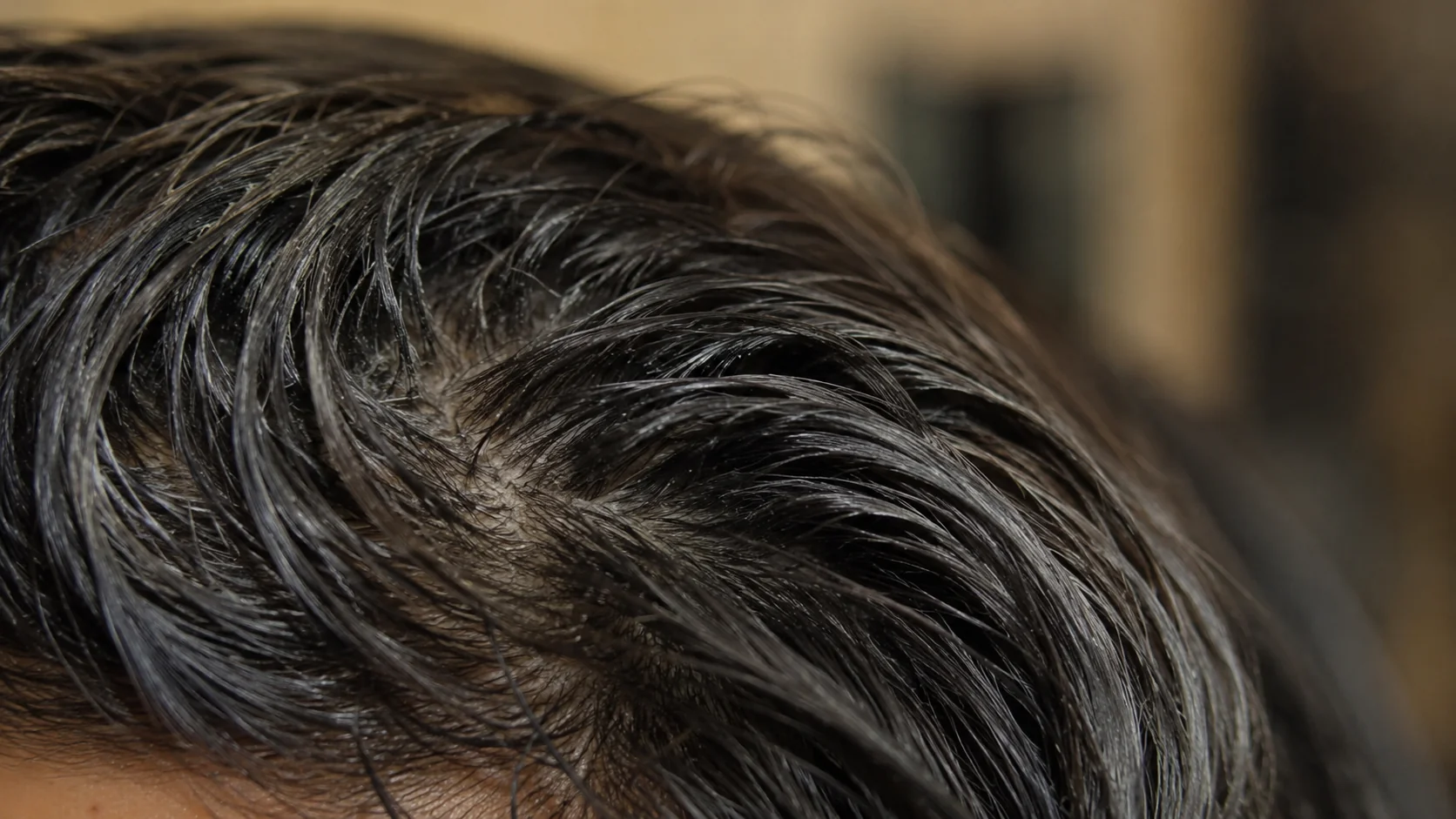
What buildup is and what causes it
Buildup is what happens when the things you put on your hair stop washing fully out and start stacking up instead. Layer by layer, a film forms on the surface of each strand. It is not a single ingredient gone wrong, it is the slow accumulation of everything that did not rinse away, plus a few things that arrive in your water.
A handful of usual suspects do most of the damage:
- Non-water-soluble silicones, the kind that coat the hair for shine and slip. They do not dissolve in plain water, so each wash adds another layer that ordinary shampoo cannot lift.
- Heavy oils and butters like coconut, castor, shea, and cocoa. Used generously, they pool on the surface rather than absorbing, especially on finer or lower-porosity hair.
- Waxes found in some pomades, gels, and stylers. They are designed to cling, which is exactly why they linger.
- Dry shampoo, which works by leaving starch and powder on the scalp. Skipping real washes lets it accumulate fast.
- Leave-in residue from creams, custards, and stylers that you reapply between washes without ever fully clearing the last round.
- Hard-water minerals, mainly calcium and magnesium, that deposit onto the hair straight from the tap and bind to it over time.
The thread running through all of it is over-application. The more product you pile on, and the more often you reach for it without a proper wash in between, the faster the film thickens. Buildup is rarely about one bad product. It is about quantity and what your water leaves behind.
Buildup is not dirt in the usual sense. It is a layer of leftover product and minerals that regular shampoo cannot fully remove, so it keeps stacking up until you deliberately strip it away.
How to recognize it
Buildup has a tell that catches people off guard: hair that feels coated or even greasy on the outside while still feeling dry underneath. The film traps an oily slick on the surface, but it also blocks real moisture from reaching the strand, so you get both sensations at once.
Watch for these signs together:
- Your hair looks dull and matte instead of shiny, no matter how clean it should be.
- Products stop absorbing. Your leave-in just sits on top and never seems to sink in.
- Hair tangles more than usual and feels rougher to comb through.
- Your scalp gets itchy or flaky as residue collects at the roots.
- It takes more and more product to get the same result, which only adds to the problem.
Porosity changes how quickly all of this shows up. Low porosity hair builds up the fastest, because its cuticle already lies flat and tight and resists absorption to begin with. Product that cannot get in has nowhere to go but the surface, so the film forms quickly and clings. If your hair is low porosity, expect buildup sooner and plan to clarify more often than someone with high porosity hair.
How to prevent it
The easiest buildup to deal with is the kind that never forms. Most prevention comes down to using less, choosing lighter, and rinsing better.
- Choose lightweight, water-soluble products. Milks, foams, and gels labeled water-based wash out cleanly. If you use silicones, look for water-soluble ones (often named with "PEG-" in front) that rinse away instead of layering up.
- Do not over-apply. Start with less than you think you need and add only if you must. Most people use far more product than their hair can actually absorb.
- Rinse thoroughly with warm water. Warm water helps lift product better than cold, and a longer rinse clears far more than a quick one. Take the extra thirty seconds.
- Wash your scalp properly. Focus shampoo at the roots and scrub gently with your fingertips. A clean scalp is where buildup gets the worst, so do not just rinse the lengths and call it done.
- Clarify on a schedule. Do not wait until your hair feels awful. A regular clarifying or chelating wash, built into your routine, stops buildup before it gets a grip.
- Deal with hard water. If your water is hard, a shower filter cuts down on the minerals reaching your hair. A final rinse with distilled or filtered water helps too.
If you only change one habit, use less product. Over-application is the biggest driver of buildup, and cutting your amount in half is the cheapest fix there is.
How to remove it
Once buildup has settled in, you need to strip it deliberately, because your normal shampoo will not. There are three main tools, and which one you reach for depends on what is causing the problem.
- A clarifying shampoo, every few weeks. This is the workhorse. A clarifying wash is stronger than your everyday shampoo and is made to cut through product film and oils. Once or twice a month is enough for most people.
- An apple cider vinegar rinse, for a gentler reset. Diluted ACV (a tablespoon or two in a cup of water, poured over after shampooing and rinsed out) lifts light residue and smooths the cuticle without the harshness of a clarifying wash. It is a good in-between option.
- A chelating shampoo, for hard-water minerals. If the trouble is calcium and magnesium from your tap, an ordinary clarifying shampoo will not touch it. A chelating shampoo contains ingredients (like EDTA) that bind to minerals and carry them away. Reach for this when your hair feels stiff and dull in a hard-water home.
How often you clarify depends on your porosity. Low porosity hair builds up fast and tolerates frequent clarifying well, so a wash every couple of weeks keeps it clear. High porosity hair is the opposite: its raised cuticle loses moisture easily, so clarify it sparingly, because over-stripping leaves it dry and brittle. Medium porosity sits comfortably in between. Let how your hair feels guide the timing more than a fixed calendar.
After clarifying
Clarifying does one more thing besides stripping the film: it leaves the cuticle open and the hair freshly bare. That is the moment moisture can finally get in, so do not waste it. Always follow a clarifying or chelating wash with a deep conditioner.
Think of it as a two-step move. The clarifying wash clears the door, and the deep conditioner walks the moisture through it while the door is open. Skip the second step and clean, stripped hair can feel dry, rough, and even more thirsty than before. Pair them every time, and clarifying stops being something that dries your hair out and becomes the thing that finally lets your products work.
Common questions
How do I know if I have product buildup?
The classic signs are hair that feels coated or greasy but still dry, looks dull instead of shiny, tangles more, and stops absorbing product. If your usual leave-in just sits on top, buildup is the likely culprit.
How do I get rid of product buildup?
Use a clarifying shampoo every few weeks, or a gentler apple cider vinegar rinse. For hard-water mineral buildup, use a chelating shampoo. Always follow clarifying with a deep conditioner to restore moisture.
Why does low porosity hair get so much buildup?
Low porosity hair has a tight, flat cuticle, so products tend to sit on the surface instead of absorbing. That surface film accumulates quickly, which is why regular clarifying and lightweight products matter most for this type.